
The ideas behind Brightland:
1. The Dimensional Analogy:
It all really started
with Edwin
Abbott Abbott's Flatland.
The main relationship between Flatland
and Brightland was in its presentation of a dimensional analogy.
Flatland
takes place within a planar universe. The narrator, A Square, is
guided by a 3-dimensional sphere to expand his horizons and try to understand
the three dimensional universe. To help him, the sphere presents
a dimensional analogy. By pointing out the differences between 0-,
1- and 2-dimensional universes, the sphere invites A-square to extend the
patterns and conjecture about the third dimension.
Brightland attempts
to continue this analogy. In Brightland, the analogy between 2-dimensional
world of Flatland
and the 3-dimensional world Monochromia is used to promote an understanding
of the true 4-dimensional universe in which Brightland takes place.
2. Embedded Shapes:
One of the ideas that
personally fascinated Jonathan was the idea that a lower-dimensional object
could not exist unless it could be embedded in a higher-dimensional space.
An example of this is the surface of a sphere, which is itself two dimensional
but cannot exist in any less than 3-dimensional space.
Brightland, from the
point of view of the player, is similar. The world of brightland appears
three-dimensional at all times, because the player is three-dimensional.
But the space of Flatland acts in ways that a Euclidean three-space cannot.
So we learn about 4-dimensional space indirectly by seeing what 3-dimensional
formations are possible through it.
3. Marathon 2:
Why Marathon
2? Why not a more realistically rendered and more modern game
engine, such as the one used by Unreal?
Three reasons, two simple,
one more complex. The first simple reason is that Marathon
2's sophisticated terminals made telling a story easy. The second
is that Jon was already familiar with the editor for Marathon
2. He has two other ongoing Marathon
2 projects: The Mission Unstoppable project and the Spontaneous Human
Combustion project. Both of these are somewhat larger than Brightland
and use more facets of the game engine, but do not use the four-dimensional
capabilties of the game.
The more complex reason
is that modern first-person games think about the world differently from
second-generation games like Marathon
2.
The first generation
of games were based on square grids of tiles. Wolfenstein
3D was a prime example. The game stored the universe as a series
of cubic objects which were either filled or empty. Empty cubes represented
the space inside rooms, while filled cubes made up the walls.
Marathon
was the first Mac game not the be square-based. In addition, it was
the first Mac game where altitude became an issue. But fundamentally, Marathon
is still a two dimensional game.
How is it possible to
make a two dimensional game that looks so three dimensional when played?
The answer can be found
by looking at how the map editor utility works.
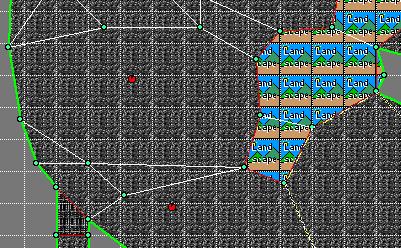 This
is a map of a level from one of Jon's older projects, called "What's you
can't see can hurt you." As you can see from this picture, the world
is defined as a series of connected convex polygons with up to 8 sides.
These polygons are called "sectors". Each sector has a floor height and
a ceiling height. And that's how it appears three dimensional.
You see height, but the computer is thinking about polygons.
To have two spaces directly
above one another, you have to make the polygons overlap. How does
Marathon
2 know which polygon you're standing in? Well, to enter a polygon,
you must either teleport or walk into it. Teleporting requires that
the level builder give the ID of the polygon to teleport into, so that's
a definite case. When you walk into a polygon, you must do so by
crossing one of its sides. Marathon
2 keeps track of which sides are shared by which polygons and calculates
your current position based on which side you crossed and where you crossed
from.
Notice that altitude
plays no role in this calculation. That means that you can have two
overlapping polygons with the same floor and ceiling heights, and Marathon
will still regard them as completely separate spaces. This is not
Euclidean behavior.
It is this feature of
being able to share space between polygons that led to the decision to
use Marathon 2
for Brightland. Because altitude plays no role in the calculation
of which polygon you're in, any value that could be assigned continuously
could be used as a dimension, and Marathon
2 would ignore it just as much as it ignores altitude. Luminosity
(how much light is in a room) was chosen because the player would be able
to detect it easily.
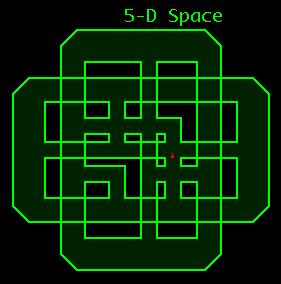 The
best demonstration of how Marathon
2 lets the same space be part of two different sectors is the multi-player
scenario 5-d space. A picture of the map is to the left. Three parallel
corridors running north-south appear to intersect three parallel corridors
running east-west.
They do share the same
space, but since none of their sides have been adjoined together, it is
impossible to get from one set of corridors to another. You have
to take one of the many twisted side-passages. This makes for incredible
disorienation at first.
Although this configuration
is impossible to build in 3-space, it is easy to build in Brightland.
Just take the north-south corridors and move them slightly brighter than
the east-west corridors, and uddenly they don't intersect at all. Marathon
simulates this behavior nicely.
We have studied several
topics which are relevant to Brightland in class this year. Coordinates
are relevant to Brightland because all of the objects within the levels
have to be identified by their X and Y coordinates plus the ID of the sector
they are in (which provides their brightness and altitude).
Slicing is key to understanding
Brightland because Monochromia is a slice of Brightland such that the lighting
levels are constant across the slice.
There is a hypercube
in one of the later levels.
The Marathon engine
uses perspective projection to change the 3-d space it creates for the
player into a 2-d projection onto the computer screen.
The Fifth Dimension:
In the level "With Thoughts
Toward Higher Things", we discover a hallway that is, in fact, embedded
in five-dimensional space. This was the most difficult part of the
story to make understandable because we don't have any direct access to
the fifth coordinate (while we could tell how high something was and how
bright and how far north and how far west. The player has to infer
the existence of a fifth dimension from a discontinuity in the brightness
of the corridor.
The reasoning which
leads to this conclusion is explained in the walkthrough.
Social Commentary:
Since there was social
commentary in Flatland,
we've decided to add a little social commentary of our own.
There are four classes
in Brightlandian society. Blue is the ruling class, then green and
purple, and orange is the lowest class. The official justification is that
blue is an indication of intelligence. The law against heresy is
not an injunction against beliefs that are against the official doctrine,
but against beliefs which (they believe) are manifestly false and could
lead people do the wrong thing because of the false information. But the
reality is that nobody has access to the truth. The blues themselves
only use this pretense to add legitimacy to their rule.
Brightland is indeed
a very dark, almost distopian presentation of what interdimensional contact
might be like. The four-dimensional creatures generally use three
dimensional creatures for their own purposes. And every dimension
shows a contempt for the one below it. This contempt is undeserved.
In our ending we point out that the Monochromians can make circuit boards
which are three dimensional. These are far superior to four-dimensional
technology because they take up no four-dimensional space, so they can
be used anywhere. The moral of that part of the story is that we
have just as much to learn from lower dimensions as from higher.