The Shape of Time
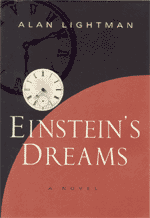
Time can be imagined as having many different shapes. Time can be thought of infinite like a circle having no boundaries, or time can be finite like a line with two endpoints: a beginning and an ending. In his book, Einstein's Dreams, Alan Lightman explores different concepts of time with geometry.
Time as a circle: "Suppose time is a circle, bending back on itself. The world repeats itself, precisely, endlessly"(8).
What if every choice that you make is repeated infinitely in time. Would you choose differently? When would the choice stop being your own?
Lightman uses an anology which brings to mind concepts such as the String Theory which are based on perception: "How could they know that nothing is temporary. That all will happen again? No more than an ant crawling round the rim of a crystal chandelier knows that it will return to where it began" (9-10).
Time as a hypercube:
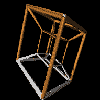
Since time can be imagined to have a shape, why not imagine Time as a hypercube? In Math 8, we have learned that we can only partially perceive a four-dimensional object in the third dimension. Perhaps what we observe of time is only three out of its four dimensions. Just as a flat, two-dimensional being would perceive a sphere passing through its dimension as a series of circles, so we would only perceive a limited understanding of time. Perhaps the understanding of timeÕs other dimension (link to my second page which explores time and dimension) could lead to time travel.
How does it relate?
Thinking about time as a physical shape is similar to thinking of the physical shape and size of dimensions in the string theory of the universe. Philosophical notions of time and the universe lend to exploration and a greater understanding of our world.