|
||||
|
||||
|
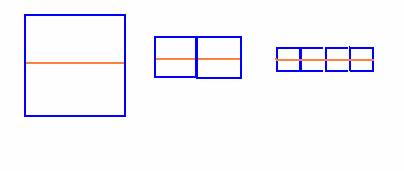
The Box Counting Dimension is one method of determining the dimension of a fractal. The interesting thing about fractal dimensions is that they are mostly non-integer. First we will start with a formula for line segments: N(r) = 1/r Where N is the number of boxes of length r that are needed to cover a figure. This can be seen in the following examples by assuming that the length of the line is 1:
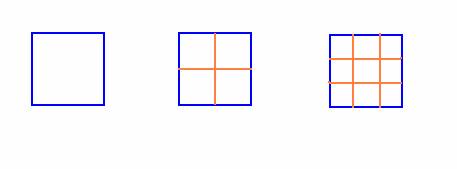
However if the figure that we’re trying to cover with boxes is two dimensional, then the formula for the number of boxes needed to cover the figure is: N(r) = (1/r)2 Where r is the length of the square with the large square having length 1. N is the number of boxes needed to completely cover the figure.
We can then generalize this formula for a box covering an n-dimensional figure: N(r) = k(1/r)^d Where r is the length of one side of the base, d is the dimension, and N is the number of boxes needed to cover the figure. We then take the log of both sides: Log (N(r))=log k + log ((1/r)^d) Log (N(r))=log k + (d) log (1/r) Solve for d: (Log(N(r))-Log k)/(log(1/r))=d Taking the limit as r approaches 0 gives us an expression for db, the box dimension: db = lim r→0 (log (N(r))/(log(1/r)). In addition, we can use the equation Log (N(r))=log k + (d) log (1/r) in order to determine d. This equation is the equation of a line with d as the slope and log k as the y-intercept. Therefore by graphing log (1/r) against log (N(r)), we can find the box counting dimension by finding the slope of the line. Here is an example of how to use box counting dimensions to determine the dimension of the Sierpinski gasket: http://classes.yale.edu/Fractals/02WorkshopII.html
|
||||
|
|