|
||||
|
||||
|
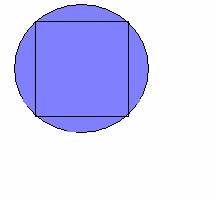
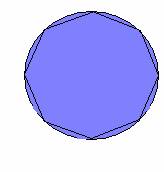
Length and Area of the Koch Curve An interesting question is how we would go about measuring the length of a fractal such as the Koch curve and what that length would be. In order to find the length of a curve, we may approximate the curve with straight lines. The length of the curve will be greater than the sum of the lengths of the lines, but by increasing the number of lines to infinity, they will eventually equal the length of the curve. For example if we start with a circle of radius ½, its circumference will equal pi. By inscribing a polygon inside the circle, we can approximate the circumference by multiplying the number of sides of the polygon by the length of each side. As the number of sides increases the total length of sides will approach the circumference: pi.
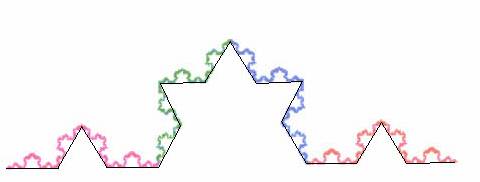
By using the formula D= L*N where L is the length of one line segment, N is the number of segments and D is the total length of the segments, we will see that as N approaches infinity, D will approach pi. Can we extend the analogy and use the same procedure to calculate the length of the Koch curve? Here is a picture of a Koch Curve:
In this case the line is of length 1, so the approximation for length is 1, but we can obviously see that the length of the curve is greater than 1.
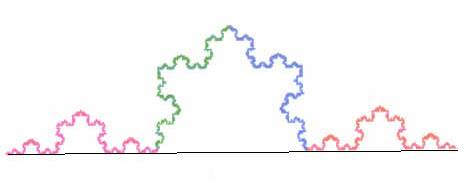
In the case above with L=1/3 and N=4, D will equal 4/3. In the case below where L=1/9, N will equal 16. Therefore D will equal 16/9.
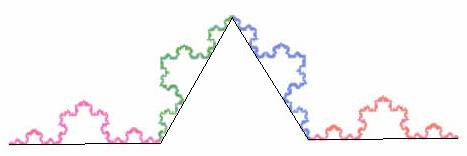
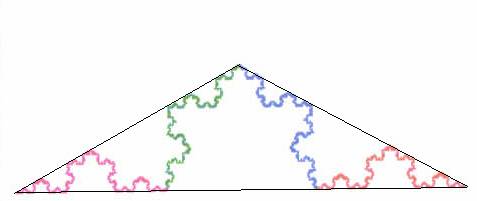
By continuing the pattern we can see that the length of the segment will be (1/3)^k and that the number of segments will be (4)^k. Therefore Dk will equal L*N or (4/3)^k. However since the Koch curve is always greater than Dk no matter how big k will get, we can say that the length of the Koch curve is infinite. Now we can consider the area of the Koch curve. We can estimate the area of the Koch Curve by drawing a triangle around the Koch curve and finding the area of the triangle. When there is one triangle, we can say the base is 1 and therefore the height is √3/6. The area will thus equal √3/12. However it is obvious that the area of the curve is less than the area of the triangle.
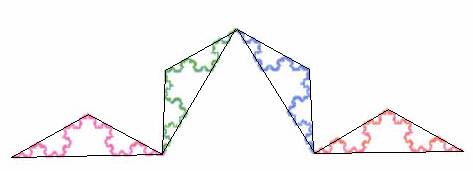
For the figure below, the base and height of the triangle are each 1/3 of the base and height from the triangle above. Thus the area of each triangle will be 1/9 of the triangle above. So the area of all the triangles will equal (4/9)*√3/12.
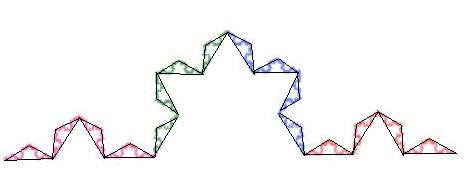
We can continue the pattern. Each triangle in the figure below has height and base equal to 1/3 of the height and base of the triangles above. Therefore the area of each triangle will be equal to 1/9 of the triangle of above. Thus the total area of all the triangles below are (16/81)*√3/12. The area of the Koch curve is less than the area of the total area of the triangles.
We can then write a general term for the area: Ak= √3/12 * (4^k/9^k). Therefore the area will decrease as k increases, but the area of the Koch curve will always be less than Ak and therefore we can say that the area of a Koch curve is equal to zero.
|
||||
|
|