|
||||
|
||||
|
While the similarity dimension formula allows
us to calculate the dimension of many fractals, it falls short when
considering fractals made up of different sized self similar pieces.
Luckily we can use the similarity dimension to derive an equation that can
be used for determining the dimension of many different kinds of
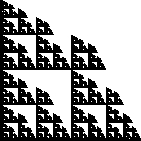
fractals. For example the fractal below is made up of self similar pieces
of different sizes and thus would require the Moran equation to determine
its dimension:
So in order to derive the Moran Equation, we start with ds= log (N)/log(1/r) Here is how the derivation works: (d) log (1/r) = log (N) (log(1/r)d) 10^((log(1/r))d) = 10^(log (N)) (1/r) d = N 1=N *r d N refers to the number of self similar pieces with a scaling factor of r. Therefore the equation will actually look like: 1=N1r1d +N2r2d +N3r3d……. Here is an example of how
we can use the Moran Equation to determine the dimension of the following
fractal:

We can tell by looking at this fractal that it is broken down into four self similar pieces. The three larger pieces have a scaling factor of ½ and the smaller piece has a scaling factor of ¼. Therefore the Moran equation would be 1= 3* (1/2)d + 1* (1/4)d In order to determine d, the dimension, we need to solve this equation first by noticing that (1/4) = (1/2)2. So: 1= 3* (1/2)d + 1* (1/22)d 1=3* (1/2)d + 1* (1/2 d) 2 By setting x=(1/2)d , we can solve the resulting quadratic equation 1=3x + x2 x2+3x-1=0 Using the quadratic formula, we can determine that x= (-3+√13)/2 or x= (-3-√13)/2. Therefore we can determine d from log (x)/ log (1/2) = d. In order to take the log of x, x cannot be negative so x must equal (-3+√13)/2. Therefore d = log ((-3+√13)/2)/ log (1/2)= 1.724 .
|
||||
|
|