|
||||
|
||||
|
Fractals have been defined in a variety of ways as the topic as developed. One of the first ways to classify a fractal was if it fit the divergent measure theorem. The divergent measure is true for some object or shape if it possesses the unusual property that when you measure its length, area, volume, or surface area indiscrete finite units as the measured value increases without finite limit as the size of the discrete units decrease to zero. This can be readily tested with an example such as the British coastline. If you were able to measure the length of the coastline with infinitely small units of length you would find that its distance would increase without bounds. The next popular definition that came along was the ever-present idea of self similarity, which has been described in detail above and still hold true today. The most recent and most complex mathematical definition of a fractal has come recently with the Hausdorff-Besicovitch Dimension. In order to understand this, we must first understand how to calculate the dimension of an object. It is also good to note that fractals in fractal geometry have their own dimension, known as the fractal dimension, which is usually, but not always a non-integer dimension that is greater, but not always, than their topological dimension, DT, but smaller than Euclidean Dimension, DE. If we start with three different objects we can begin to understand how to calculate the dimension of an object. If we start with a line we can see that it is divided into four equal parts, each of which is self similar to the original except ¼ of the size.
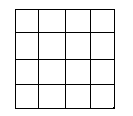
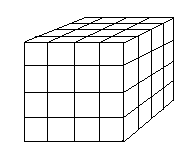
The square below is also broken into smaller pieces, each of which are ¼ the size of the original square except this time it takes 16 pieces to recreate the same effect. We can do the same break down with a cube except that this time we find that we will need to divide the cube into 64 pieces in order to create the same self similar effect. We can deduce a pattern from dividing these three objects up in a similar fashion. 4=41 16=42 64=43 This then gives us the more general equation N=SD, where N the number of small pieces that go into the larger one, S is the scale to which the smaller pieces compare to the larger one and D is the dimension. Using a bit of math we find that we can solve for D and find that D = log N/ log S, and this dimension is the Hausdorff-Besicovitch dimension. Stated formally the Hausdorff definition states that for a shape F embedded in D-dimensional Euclidean space SD, define the measure Me to be Me = eD Ne, where e is an arbitrarily small value and Ne is the minimum number of points in the space SD such that every point in F lies within a radius e of at least one point. States otherwise, lime->0 [ ln(Ne) / ln(e) ]. More recently other definitions have arisen such as the natural definition which says a fractal can be a geometric figure of nature that combines the following characteristics: a) its parts have the same structure as the whole except that they are at a different scale and may be slightly deformed b) its form is extremely irregular or fragmented and remains so whatever the scale of examination c) it contains “distinct elements” whose scales are very varied and cover a long range. The “Simplest Definition” has also arisen which calls a fractal any picture obtained by repeating a mathematical formula to every point on a given area. Although these definitions are very similar to some of the older ones, they are sometimes grouped into their own categories for classifying certain types of fractals.
|
||||
|
|