
How - Detailed Game Design
Part 1. Design:
It's not easy to put
a 4-d idea onto a 2-d piece of paper. Once Jonathan had become good at
drafting levels, he tended to draw 2-d cross-sections parallel to the ground,
and then describe their interrelation in words. For instance, he
might say: "This is the elevator in the middle of the second floor
marked 'Elevator to 3,'" or more briefly, "from 2."
In cases of changing
brightness, it just meant that Jonathan had to take more slices.
Since he already had a fairly strong mental conception of the level to
be built, none of the levels were fully drafted.
Jonathan and Alex developed
the plot for the game, by comparing Flatland and the features available
in Marathon, and mixing and matching the two. The resulting storyline
is only marginally related to Flatland. The element of personal discovery
is still there, but there is also struggle against the existing power structure.
Soon thereafter Alex
began writing dialogue, journal entries, and the web page.
The plot that was developed
was a branching plot, with different territory, plot, and character developement
available depending on the decisions the player makes. This plot
is also more dimensional than the classic Marathon plot, where there was
a definite sequence of levels. (Marathon Infinity has a more interesting
plot topologically).
As of this writing,
only one branch of the plot has been followed to completion, namely the
branch where the player calls the police after finding the 4-d character
and the escaped convict in his house. When the whole plot tree is
finished, there will also be a section where the player can walk along
the edges of a hypercube, and a section of space which is folded five-dimensionally.
Also, there will be a waepon with which to fight the blue hordes and free
the other colors from their four-dimensional tyranny.
Part 2. Building the levels.
Two dimensions:
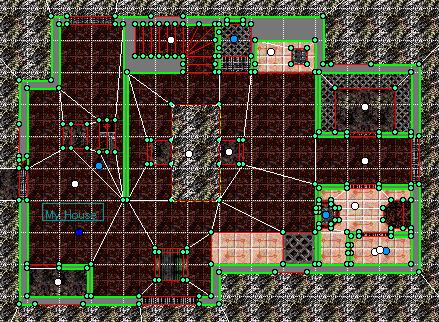 As
mentioned in the "Why?" section, Marathon's internal
way of storing levels is two-dimensional. The first step in building
a Marathon level is to lay out a flat structure which represents the geometry
of the level. This is the shape you see when you use the auto-map
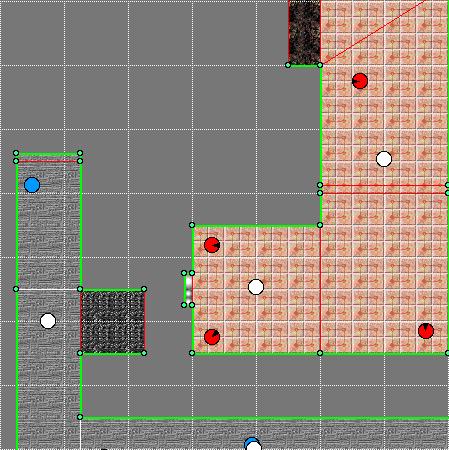
key in the game itself. The map may overlap itself in two dimensions.
The picture to the left is a scene in the editor from Monochromia.
Three dimensions:
The next step is to add different heights to the floors and ceilings of the two-dimensional polygons. In three dimensional levels such as Monochromia, the four dimensional step can be skipped entirely.
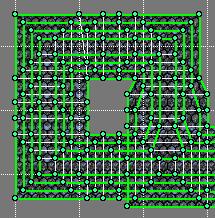 Here
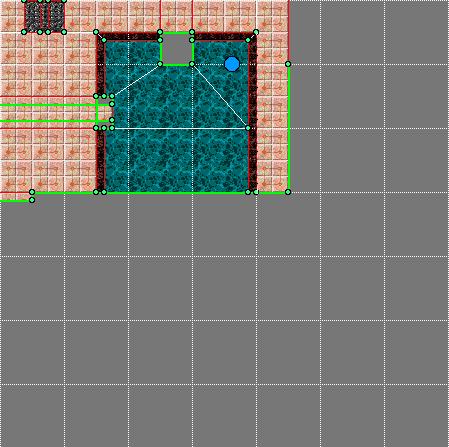
is the three-dimensional spiral staircase from level 3 (The Traitor's Reward)
before it was finished. The masses of parallel lines are because
each wall was offset slightly so that they were easier to tell apart.
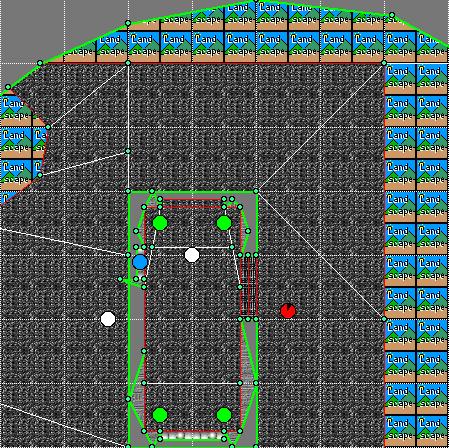
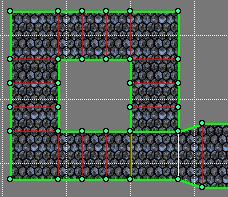 Here
is the final product version of that stairway. All the lines were
pushed to be on top of each other so that it looks neater, but now the
four lower floors of the staircsae can not be accessed because the top
floor is in the way.
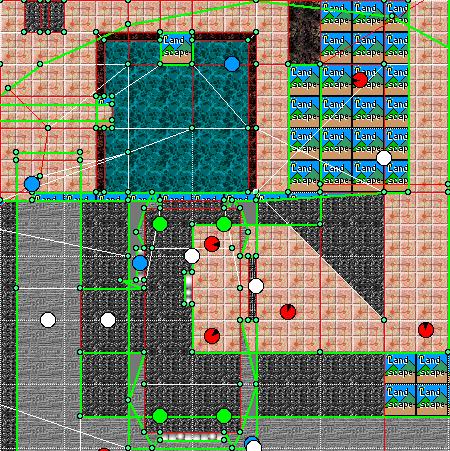
One way to get at those
floors is to use layers. Layers are numbers that Pfhorte applies
to polygons. You can then choose to view all polygons with a given
layer number, or all those without a certain layer number. Above
are consecutive views of layers 1-4 in the level "What you can't see can
hurt you" from another one of Jonathan's projects.
Four dimensions:
After adding heights, it is possible to change the lighting values of walls and floors and ceilings. In normal Marathon levels, this step has no additional significance, but in Brightland, we use lighting to signify a fourth dimension. Note that the Marathon engine does not treat sectors with different brightnesses any differently. That is something Jonathan had to add himself as the author. Brightland would have worked just as well without the different lighting intensities. It just would have been harder to understand what was happening if there was no visual way to tell four-dimensional position.
Four dimensions plus time:
Time becomes involved when some of the polygons are elevators. Elevators are polygons where the floor or ceiling height changes. It is possible to connect elevators to lights, so that the brightness of a sector changes as well. Elevators (otherwise known as platforms) gave Jonathan full dynamic control over all 4 dimensions.
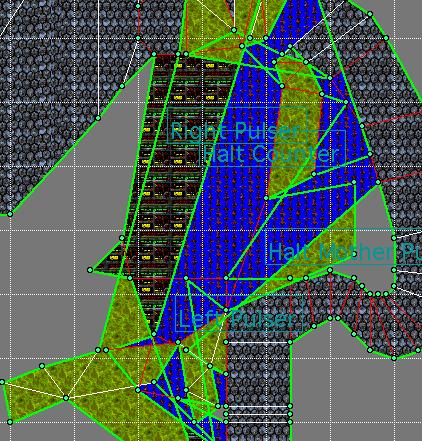 Unfortunately,
elevators are very simple, so they can't do much. Sometimes it takes
a lot of elevators to model relatively simple behavior. Here is the
network of elevators in level 3 that is responsible for making the 4-dimensional
feet stomp (Side note: These elevators don't work yet. If the problem
proves too intractible, they may be removed. The feet would then
be made to work by simpler but less versatile methods).
Terminals:
With the application Hex!, Alex's dialogue was placed them inside the terminal screens along with graphics. Terminals are crucial to giving plot and background.
Physics:
Using Alchemist, Physics Converter, and Anvil, the built-in physics model was altered. The updated version, called Brightland Physics, models the relative behaviors of the blues, Tom, Jon, and the player, as well as has the readouts for the 4-dimensional weapon from level 5.
Further Questions:
Jonathan used a lot of
shady tricks to get this level to work. If you'd like to know what's
going on where, you can email Jonathan,
and he would be glad to trade Marathon level-building tricks with you.
It's a dying art, but it's not lost altogether...